17 July 2026
Mihir Kelshiker
Credible post-market clinical follow-up (PMCF) for an AI medical device is proactive, justified, and controlled. Here is what those three principles mean in practice.
PMCF is one of the most consequential and frequently underdeveloped parts of a regulatory submission for AI as a Medical Device (AIaMD).
That is because an AIaMD does not stop changing once it is deployed. Clinicians' interaction with the device matures with familiarity and systemic implementation, while patient populations can shift, and inputs can change. PMCF is the principal mechanism by which you must detect, quantify, and address these changes.
Three principles describe what good PMCF for an AIaMD looks like: proactive, justified, and controlled.
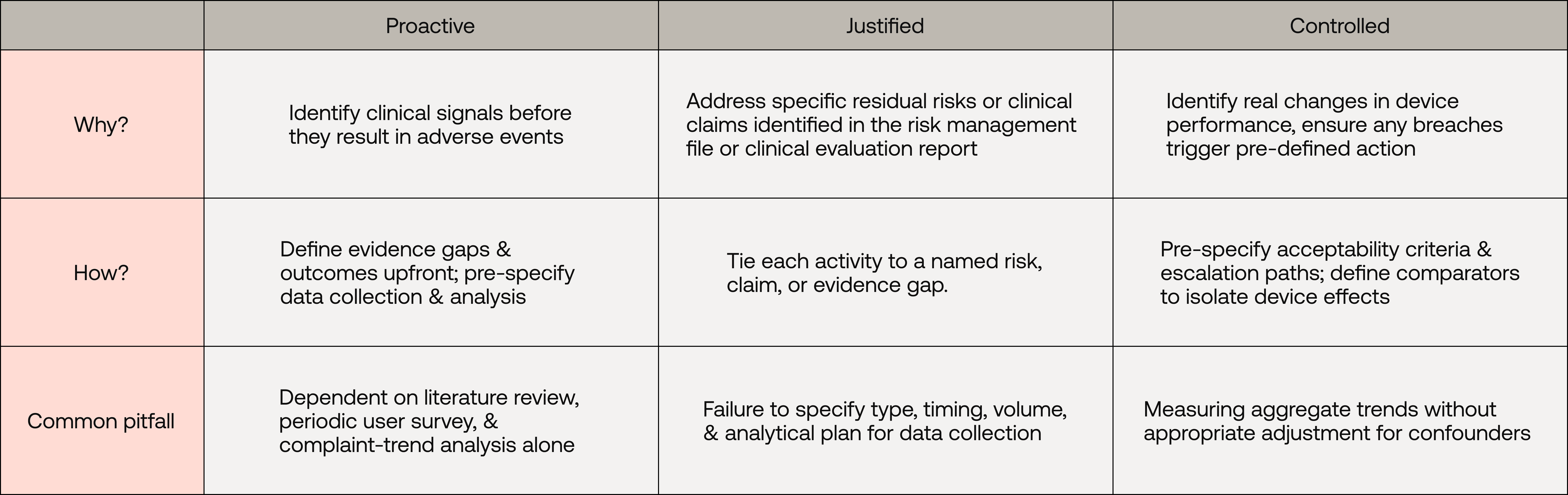
Requirements:
MDR Annex XIV Part B: Sets out the PMCF plan and reporting obligations
Article 61(11): Requires the clinical evaluation report and underlying clinical evidence to be actively updated with PMCF data throughout the device lifetime
What distinguishes PMCF for AIaMDs?
The clinical workflow (device-user interaction) is the conduit to benefit
Most AIaMDs only deliver a benefit when a clinician acts on the output appropriately. For example, a triage tool reporting 95% sensitivity in a retrospective held-out test set produces no patient benefit if, in practice, clinicians override its prioritisation. PMCF for an AIaMD therefore has to evaluate how the device is used in the clinical pathway, not solely whether the algorithm still classifies correctly. Relevant measures include clinician reliance, time-to-action, override rate, and downstream outcomes for patients flagged versus not flagged. Without these, the manufacturer cannot evidence the claimed clinical benefit in real-world use.
Performance can degrade silently
AIaMD performance can degrade without any visible failure, through three mechanisms.
Data drift: inputs change e.g. a new type of scanner or a revised acquisition protocol
Population shift: a change in prevalence impacts positive predictive value, or off-label use (indication creep)
Concept drift: ground-truth changes e.g. new guidelines or diagnostic criteria
None of these announces itself, so complaint data will not catch it. PMCF has to be designed to.
Subgroup performance is where clinical harm typically materialises
Aggregate performance can mask inequitable performance in subgroups. A device reporting 92% sensitivity overall but 71% on patients with darker skin, or on women under 40, or on a specific scanner model, has a clinical safety gap that headline figures will not surface. Credible PMCF is therefore powered to detect subgroup-level deterioration, with the relevant subgroups, metrics, and thresholds pre-specified in the plan.
The State of the Art (SotA) changes over the device's lifetime
The benchmark for acceptable performance at the point of certification is not the benchmark three years later. New devices reach the market, clinical guidelines are updated, and comparator standards shift. PMCF for an AIaMD must therefore include periodic re-benchmarking against current SotA, rather than a single comparison fixed at certification.
What does a good PMCF plan contain?
MDCG 2020-7 sets out the structure of a PMCF plan. For AIaMDs, five elements warrant particular attention.
Precise, device-specific objectives
Objectives should be expressed in terms of the specific clinical benefit claims, the patient subgroups in which those claims must hold, and the metrics by which they will be judged.
Example: an AIaMD for triage of chest radiographs
Generic: Measure real-world performance
Specific: Measure and report sensitivity for pneumothorax detection in patients aged over 75 across at least three deployment sites, stratified by scanner manufacturer
Explicit linkage to clinical data gaps and residual risks
Regulatory assessments progress rapidly and smoothly when clinical data gaps are acknowledged and presented upfront, clearly, and with precise linkage to planned PMCF activity. For example, each PMCF activity should be traceable to an entry in the risk management file (per ISO 14971) or a gap identified in the CER.
Example of a residual risk: R-12: under-representation of patients with implanted devices in training data
Example of a PMCF activity: 12: prospective performance monitoring in patients with pacemakers across participating sites
Methods and procedures appropriate to the question
The plan should specify the data source (registry, prospective study, retrospective evaluation, real-world data feed), the sampling approach, the comparator (where one is used), and how the data will be analysed. A literature review and a complaint-trend analysis remain useful inputs, but they must be supplemented by methods capable of detecting the failure modes identified in the CER. The methods should also be realistic to carry out. An aspirational plan that sites cannot support in practice produces poor data.
Pre-specified acceptability criteria and escalation paths
For each metric, the plan should define what constitutes acceptable, marginal, and unacceptable performance, and the action that follows in each case.
A justifiable reporting cadence based on the dynamics of the device
Cadence should be calibrated to the rate at which inputs and use can change: more frequent for devices with rapid software update cycles, exposure to multi-vendor imaging environments, or known sensitivity to acquisition parameters; less frequent where clinical use is highly standardised. The plan should also pre-specify the trigger conditions that bring the next assessment forward, such as a substantial change to a connected electronic health record (EHR) system, the publication of new clinical guidance, or the addition of a new deployment market.
What does a good PMCF report look like?
Three characteristics distinguish a credible PMCF report, which follows the structure set out in MDCG 2020-8.
Analysis of primary data
The report should present the underlying field data (performance by site, by subgroup, over time), not summaries of summaries, and the analyses run on it. Where data is missing, the report should say so and explain the implication for the conclusions drawn.
Updated state-of-the-art benchmarking
The report should re-examine the comparator landscape: newly CE-marked devices in the same indication, recent peer-reviewed performance data, and any updates to clinical guidance. The conclusion should explicitly address whether the device's performance, as evidenced in the field, remains consistent with the current state of the art.
A clear, evidenced conclusion on the benefit-risk determination
The report should determine whether the device's benefit-risk profile remains favourable. Where the data raise concerns that do not yet warrant action, the report should record them and set out how they will be tracked in the next cycle.
How to make it feasible
A frequent challenge to credible PMCF for AIaMDs is that the data infrastructure required is impractical. In our experience that is often overstated, but it does require deliberate design choices upstream of post-market.
Real-world data and structured deployment environments
Where the device is deployed in environments that capture inputs, outputs, and outcomes in a structured form, much of the data needed for PMCF is generated as a by-product of normal clinical operations. The same data can also reveal real-world use, device deficiencies, and misuse or off-label use, all of which bear on safety and performance over the device lifetime. Designing the device's deployment architecture with this in mind is an effective way to reduce the marginal cost of each PMCF cycle. Contracting for access to the relevant data with deploying institutions is generally permissible under standard Data Processing Agreements under Articles 6(1)(e) and 9(2)(h) of the General Data Protection Regulation (GDPR).
See also our post on secure data environments for PMCF.
Participation in clinical registries
National and disease-specific registries are an underused source of long-term outcome data for AIaMDs, particularly for indications where outcomes are not observable inside the manufacturer's own data feed. Registry participation can be specified in the PMCF plan and operationalised through site-level agreements at the point of deployment.
Interoperability with EHR and clinical-system data
Standardised interfaces (HL7 FHIR, DICOM, IHE profiles) allow the device to receive structured context about the patient and to log outputs in a form that downstream analyses can use.
For more, see our post on real-world data and evidence for AIaMD.
Conclusion
Good PMCF for AIaMDs is proactive in design, justified against the residual risks identified in the CER and risk management file, and controlled by pre-specified acceptability criteria. It means data infrastructure is planned alongside device development and performance testing. A well-designed PMCF system also makes future changes to the device easier to verify and validate, the foundation of a credible predetermined change control plan. Done well, PMCF directly supports AIaMD manufacturers to update, improve, and defend their devices over their full lifetime on the market.