Clinical significance for SaMD: why context matters
The significance of device outputs is based on more than just the content. It must also factor in when and how information is presented, and what it will likely lead clinical users to do.
The IMDRF framework for risk categorisation requires manufacturers to classify the significance of information a device provides by how it is used in healthcare decisions.
Unfortunately, manufacturers may misinterpret this and describe only what the software shows on screen (such as scores, lists, or confidence intervals) rather than what the information provided by the device actually leads to in clinical hands.
The significance of information materially influences the SaMD category, which can be used to inform the EU MDR device classification. Getting the significance right can therefore prevent an incorrect risk class.
Rather than just the output on screen, it’s important to keep the significance focused on the overall clinical workflow too.
Three degrees of significance
IMDRF divides the significance of information into three purposes:
- To treat or to diagnose
- Information that will be used to make an immediate or near-term action to treat, diagnose, detect or screen
- To drive clinical management
- Information that guides the next diagnostic or treatment interventions, triage of patients, or identifies early signs of disease; the information triggers an immediate or near-term action
- To inform clinical management
- Information that does not trigger immediate or near-term action; it rather frames options or aggregates relevant clinical context
These are crucial and we'll refer to them throughout the rest of this post.
Their definitions lead us to two key points:
- Action outweighs information — a screen presenting seemingly non-directive information can still drive decisions if that’s how it is used in practice; what action is taken from that information is crucial
- Workflow placement matters — where the SaMD sits in the clinical pathway (e.g. triage, diagnostic workup, or treatment selection) can often affect its significance as much as the content it displays
Three guiding principles
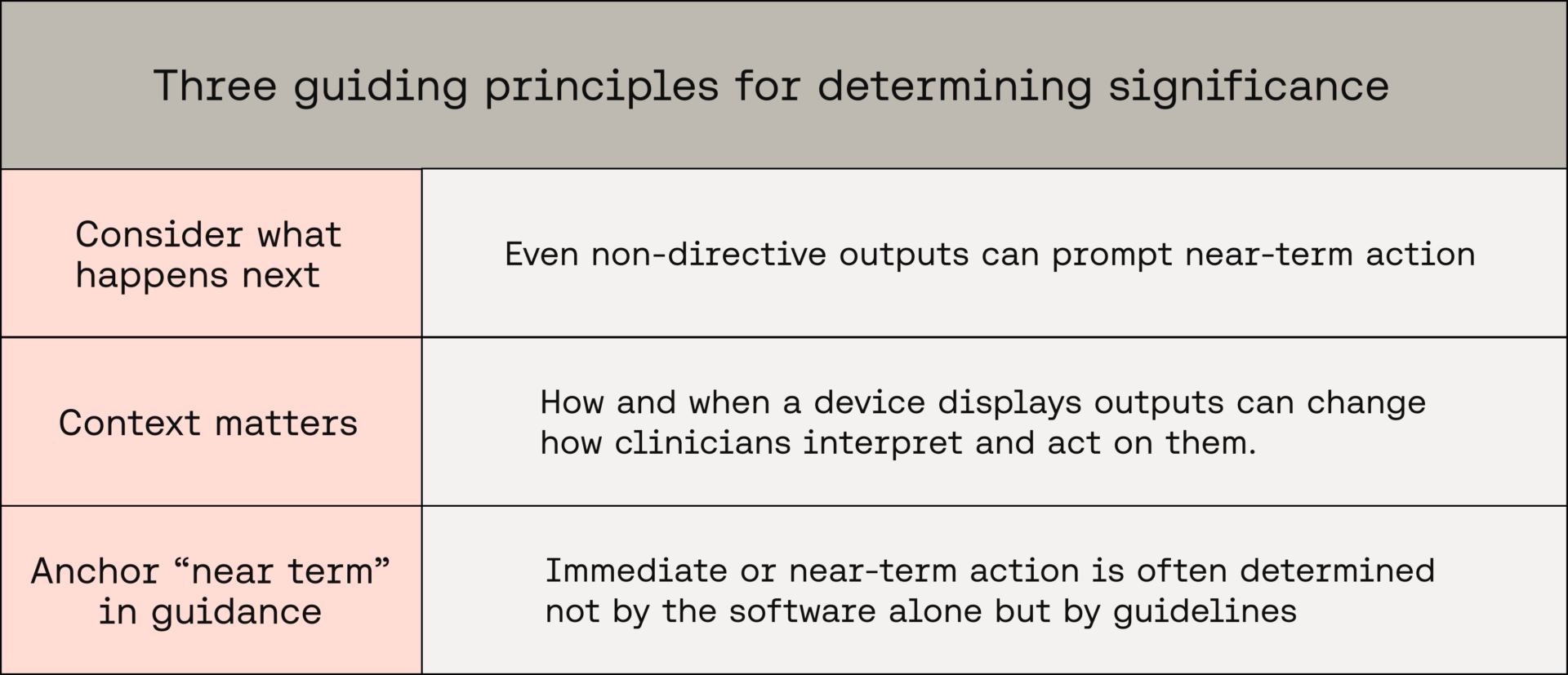
1 — Always consider what happens next
A common pitfall is claiming that the device only “informs” clinical management because the output is not prescriptive and doesn’t explicitly direct users.
The significance of information should first encompass whether it is reasonably likely for a near-term action to occur. If reviewing the output is expected to lead to expedited investigations, triage, or treatment decisions, then the software is not simply informing, it is driving clinical management (at a minimum).
As a rule of thumb, the more serious the healthcare situation or condition, the higher the significance of information is likely to be, because more serious contexts are more likely to require immediate action.
To claim a device only informs, a manufacturer must present a compelling, evidence-based rationale that near-term action is not reasonably expected from the intended user in the intended setting.
Consider this example: symptom-based differential lists. Even without probabilities or recommendations, a list providing differential diagnoses may prompt urgent investigations, referrals, or management plans. In these clinical scenarios, this aligns with driving clinical management, not just informing.
2 — Context matters
How and when a device displays outputs can change how clinicians interpret and act on them.
The outputs of a SaMD receiving inputs from an investigation at the end of a clinical pathway can be interpreted as a diagnosis depending on the way they are presented.
Let’s consider a PET scan, the gold standard for identifying metastasised cancer, as an example.
Providing deterministic outputs — e.g. metastasis present or metastasis absent — meets the IMDRF definition of “to diagnose”, as this information is used immediately at the moment of diagnosis, even when a specialist reviews it. Indeed, IMDRF specifically cautions that SaMD can reshape workflows in unanticipated ways and affect the clinical judgement of specialists.
By contrast, probabilistic outputs — e.g. 64% matching a metastasis; 95% CI: 52–76% — generally “drive” clinical management by aiding in diagnosis or treatment decisions. Outputs that portray uncertainty ultimately invite clinician scrutiny, such as through showing confidence bounds and avoiding binary labelling, which is an important safety consideration on top of classification implications.
3 — Anchor “near term” in accepted clinical guidance
Whether SaMD information simply “informs” is dependent on whether it triggers immediate or near-term action. That is often determined not by the software alone but by prevailing clinical guidelines and treatment protocols.
Where possible, align your significance determination with these objective sources to make it more independently verifiable.
For example, consider two types of risk calculator:
- The CHA₂DS₂-VASc score estimates stroke risk in people with atrial fibrillation. In many settings, because of clinical guidelines, a high score means the doctor will prescribe blood thinners during the same visit. As a treatment decision is made right away, this qualifies as (at least) “driving clinical management”
- The QRISK3 score estimates someone’s lifetime risk of cardiovascular disease. The guidelines recommend its use for long-term discussions about lifestyle changes or general health planning, without forcing an immediate prescription. In this context, it can be seen as “informing clinical management” given the long-term context
A practical rubric
Using a rubric helps frame the information a device is providing. It ensures consistency across intended purpose, workflow placement, and expected actions, reducing the risk of misclassification.
When considering your significance of information, organise it around two tests:
- Action test
- What will the intended user do next, in the declared environment, based on the information provided?
- Interpretation test
- How would a less experienced user naturally interpret the output?
Key takeaways
Getting “significance of information” right means stepping back from the interface and focusing on the clinical reality: what your intended users are likely to do next, in the declared setting, and how soon.
Anchor your determination in the workflow and, where possible, in accepted guidance — then consider it against how the output will naturally be interpreted, especially under time pressure and with less experienced users.
The aim is simple: match significance to the action your software realistically sets in motion.
Related




Want Scarlet news in your inbox?
Sign up to receive updates from Scarlet, including our newsletter containing blog posts, sent straight to you by email.