Wellness or mental-health SaMD? How to know the difference
The market is full of products marketed under 'wellness', such as mood trackers, CBT-style exercises, and chatbots. The appeal is obvious, but the regulatory boundary for when these products cross into digital mental health technologies (DMHTs) is not.
In this blog we will cover the increasing need for DMHTs and the distinct differences between them and wellness products, taking into account aspects such as functionality and marketing claims.
Why do we need DMHTs?
One in seven people live with a mental-health condition, but only a quarter of those receive treatment. Matched with a shortage of trained mental-health professionals worldwide (four psychiatrists per 100,000 people globally), there is a demand for better and timely access to well-evidenced and safe psychological interventions. The Harvard Business Review noted that companionship was the leading use of generative AI in 2025.
In comes digital mental health tech. These devices aim to reduce the current burden on healthcare systems by providing treatment, recommendations, and/or techniques for managing psychological symptoms.
What kind of DMHTs are there?
There are a variety of tools that could be classed as a DMHT, including but not limited to:
- Mobile applications: Apps for mood tracking, CBT delivery, meditation, and self-management
- AI-powered tools: Chatbots, virtual therapists, and algorithm-driven assessment tools
- Telehealth platforms: Triage for remote therapy sessions and digital consultation platforms
- Wearable devices: Sensors monitoring physiological indicators of mental health (e.g. stress responses)
How does functionality play a role?
The Medicines and Healthcare Products Regulatory Agency (MHRA) released updated guidance in 2025 regarding the qualification of a DMHT as Software as a Medical Device (SaMD) based on the functionality of the device.
DMHT devices with low functionality rarely hit the mark of qualifying as a SaMD, including functions such as:
- Stores data/information without change
- Communicates data/information without change or prioritisation
- Processes user instruction to show fixed content in a similar manner to a user choosing a chapter in a digital book, audiobook, or video
- Processes data/information with an easily verifiable calculation/algorithm
In contrast, devices with high functionality, typically meeting the requirements of a DMHT/SaMD, include functions like:
- Processes user instruction with an interactive and/or personalised output
- Processes data/information with a calculation/algorithm that is not easily verifiable
- Processes data/information using AI
What is the difference between a wellness product and a DMHT?
Wellness products typically focus on general wellbeing; they may support healthier routines, improve sleep hygiene, encourage mindfulness, or help users reflect on how they feel day-to-day. They stop short of claiming to treat, diagnose, prevent, or alleviate a recognised mental-health condition.
Intended purpose and clinical claims
In practice, many wellness apps look similar to DMHTs at a feature level. They may include journaling prompts, mood logs, breathing exercises, or educational content, but the key difference is in the intended purpose and the clinical performance claims. If the product is framed as supporting wellbeing in a broad sense, without tying outputs to a clinical outcome, it is more likely to fit the scope of a wellness product.
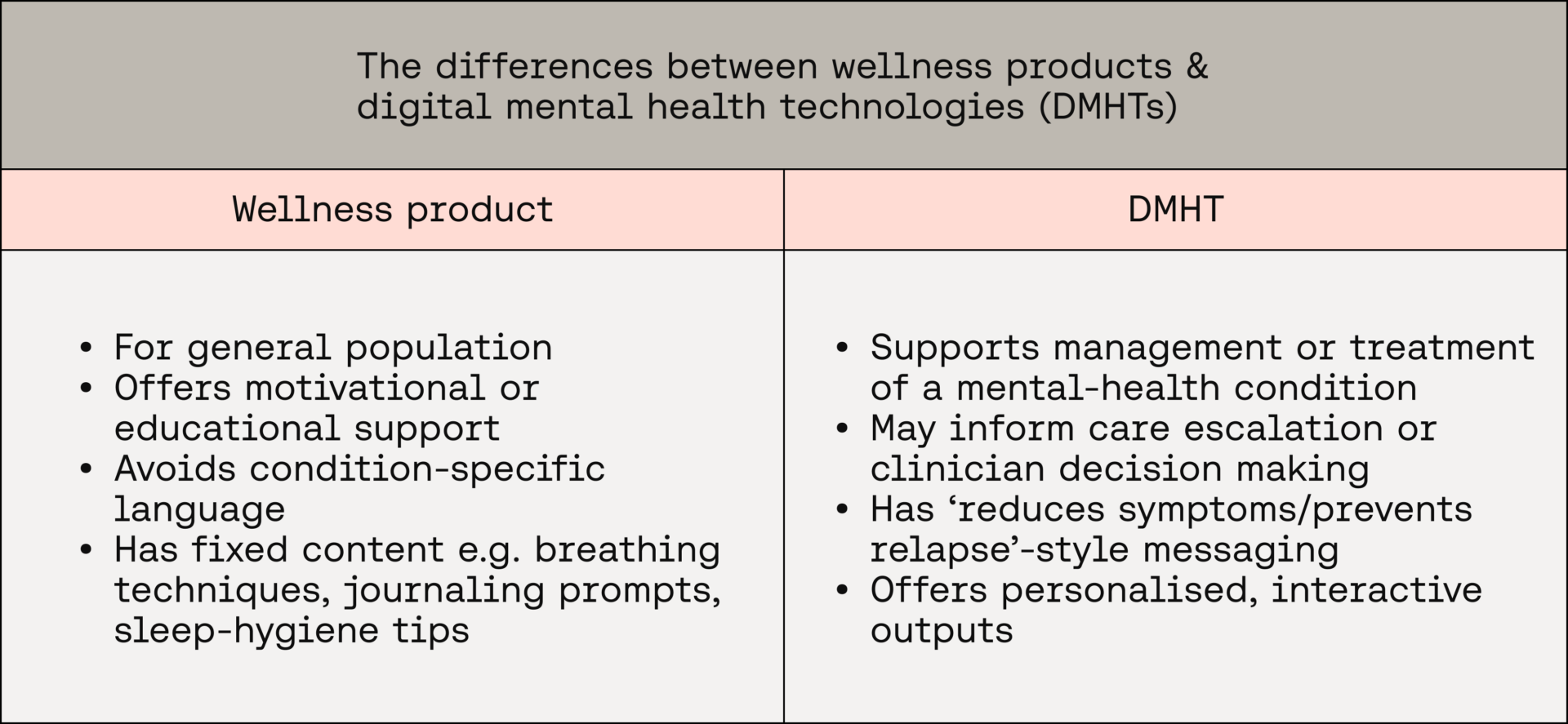
Where the boundary starts to blur is when wellness functionality becomes meaningfully personalised, interpretive, or directive. For example, a tool that merely displays a user’s self-reported mood over time is very different from a tool that interprets those entries, highlights deterioration or changes in symptoms, recommends certain CBT-based practices, or flags a user as being at risk of a clinically relevant psychological condition.
Marketing and insights from user profiles
The language used to market a product can also impact the boundary between a wellness product and a DMHT/SaMD. Phrases such as ‘helps to manage your stress’ or ‘supports mindfulness’ will generally be within the scope of a wellness product. However, language that implies clinical performance, or concerns a specific mental-health condition, such as ‘reduces depression/anxiety symptoms’, ‘prevents relapse’, or ‘recommends evidence-based interventions’, suggests a medical indication, even if the UI still looks like a general wellness app.
It is also important to consider the user profiles of the product when on the market and real-world evidence can be collected. If it is predominantly being used by individuals with a diagnosed mental-health condition, it is unlikely to be a wellness product.
So is my device a wellness product, or a DMHT?
A practical way to approach qualification is to step back from features and ask two questions:
- What is the product intended to do?
- What is the user expected to do with its output?
If the device is intended for general wellbeing and the output is informational or motivational (e.g. fixed content, simple tracking, or non-personalised prompts), it is more likely to sit in the wellness category.
If the device is intended to support the management of a mental-health condition, and the output is personalised, interpretive, predictive, or directive (e.g. risk flagging, treatment recommendations, symptom assessment, symptom management, or algorithmic triage), you are much closer to DMHT territory.


Want Scarlet news in your inbox?
Sign up to receive updates from Scarlet, including our newsletter containing blog posts, sent straight to you by email.